11 de julho de 2011

Birding Canarias organiza viagem às Selvagens a partir de Tenerife


Septiembre Islas Salvajes. Las grandes desconocidas del Atlántico. (cuatro días)

Las aguas entre las islas Salvajes y Canarias están consideradas como una de las mejores zonas del planeta para la observación de varias especies de cetáceos y aves marinas. La navegación hasta estas islas desiertas es una autentica aventura de marinos, que termite al viajero disfrutar de la navegación a vela con la ayuda de los vientos alisios y el deleite nocturno por el estrellado cielo en medio del océano.
Salida del jueves día 1 al domingo día 4 de septiembre de 2011.
(La noche del miércoles anterior a la salida se duerme en el barco fondeado en puerto).
Itinerario: Tenerife – Salvaje Grande – Salvaje Pequeña – Tenerife.
Transporte: moto-velero de 13,5 metros de eslora con cuatro camarotes dobles
Número máximo de viajeros: 6. El número mínimo de personas para realizar el viaje es de 4 viajeros.

Crónica del tour a las islas Salvajes de junio de 2011 (ENGLISH VERSION)


El pasado fin de semana realizamos un nuevo tour de seawatching a las islas Salvajes, este año la novedad es que hemos navegado durante el mes de junio, fechas idóneas para la observación de aves marinas pelágicas nidificantes en los archipiélagos macaronésicos. A continuación mostramos un pequeño resumen de las observaciones realizadas.

Jueves 9 de junio de 2011. Navegación Tenerife a Salvaje Grande.

(Foto: Juan José Martín)
Zarpamos desde el puerto de Santa Cruz de Tenerife a las 6:00 h. y partir de las 8:00 h. cuando nos encontrábamos a la altura de los Roques de Anaga comenzamos a observar aves marinas.
Realizamos un buen número de observaciones hasta las 21:00 h. cuando se produjo la puesta de sol a unas 20 millas náuticas al sur del islote de Salvaje Grande.

Pardela cenicienta Calonetris diomedea..... algo más de 200 exx.
Petrel de Bulwer Bulweria bulwerii..... 31 exx.
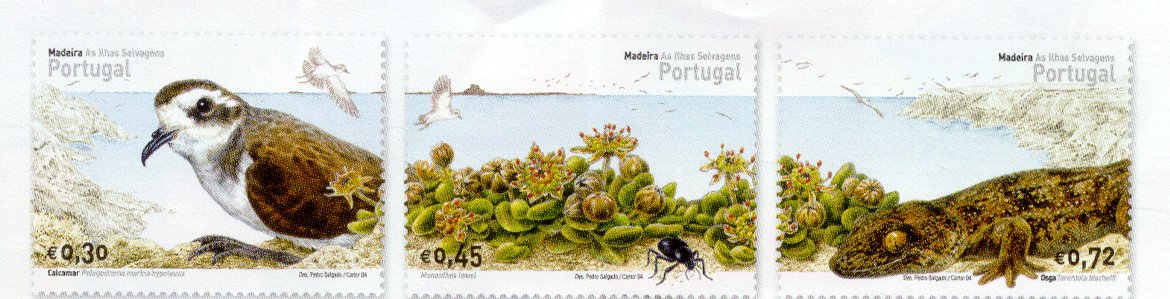
Paiño pechialbo Pelagodroma marina..... 6 exx.
Charrán común Sterna hirundo..... 1 ex.
Gaviota patiamarilla Larus michahellis..... 25 exx. aprox.

Otra fauna de interés:
Delfín común Delphinus delphis..... 2 exx.

Viernes 10 de junio de 2011. Visita a Salvaje Grande.

(Foto: Birding Canarias)
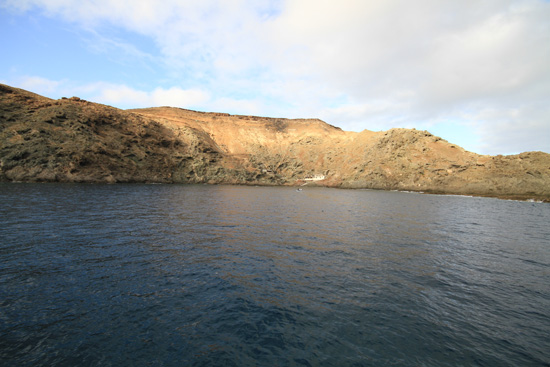
Bahía Das Cagarras en Salvaje Grande.

Después de una larga travesía de unas 20 horas llegamos a la bahía Das Cagarras donde fondeamos y pasamos la noche escuchando el reclamos de las pardelas cenicientas, paiños de Madeira y pardelas chicas.
Al amanecer pudimos disfrutar del vuelo de varios charranes comunes y pardelas que salían y entraban alas huras, hecho que solo tiene lugar en esta recóndita isla. Tras desayunar en nuestra embarcación desembarcamos para pasar el día en tierra y rea
lizamos una ruta a pie por la isla en compañía de Lourenço, el vigilante de la Naturaleza del Parque Natural Da Madeira encargado de la vigilancia de la isla.

(Foto: Birding Canarias)
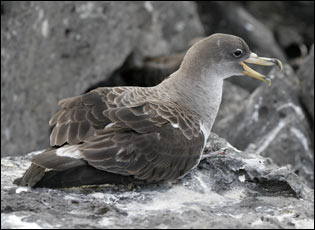
Pardela cenicienta Calonetris diomedea, se observarón varios centenares de nidos ocupados por adultos incubando. Además de algo más de un millar de aves volando al atardecer entorno a la bahia Das Cagarras.

(Foto: Birding Canarias)
Centenares de pardelas volando al atardecer en las próximidades de la Bahia Das Cagarras.

Pardela chica Puffinus baroli, se escucharon alrededor de 10 ejemplares la noche del 9 de junio.
Petrel de Bulwer Bulweria bulwerii, pudimos observar varios ejemplares incubando en sus colonias de crias bajo acumulos de piedra.
Paiño de Madeira Oceanodroma castro, localizamos el cadáver de un ejemplar en las cercanías de una de las colonias de cría que estudian biólogos de la Universidad de Lisboa.
Rabijunco etéreo Phaethon aethereus, observamos un ejemplar adulto en vuelo en la bahía Das Gallinas.
Charrán común Sterna hirundo, se observaron varios ejemplares volando entorno al islote.
Gaviota patiamarilla Larus michahellis, se observaron entorno a 20 ejemplares volando en diversos puntos de la isla. Además de 2 pollos volantones correteando por los llanos del interior del islote.
Vencejo común Apus apus, se observan un mínimo de cuatro ejemplares volando junto a golondrinas y aviones.
Bisbita caminero Anthus berthelotii, es la única ave terrestre nidificante en la isla, se observaron varios ejemplares adultos y jóvenes tantos en los llanos del interior como en la franja costera en la bajamar, donde se alimentaban de invertebrados marinos.
Avión común Delichon urbicum, se observa alrededor de 75 ejemplares volando en diferentes puntos de la isla.
Golondrina común Hirundo rustica, junto al mayor grupo de aviones comunes, unos 40 ejemplares, observamos tres golondrinas.

Sábado 11 de junio de 2011.
Navegación desde Salvaje Grande a Salvaje Pequeña.
Entorno a las 10:00 h. partimos rumbo a Salvaje Pequeña con el objetivo de buscar nuevas especies de aves marinas.
Pardela cenicienta Calonetris diomedea..... algo más de 300 ejemplares.

(Foto: Juan José Martín)
Petrel de Bulwer Bulweria bulwerii..... 16 exx.
Paiño pechialbo Pelagodroma marina..... 15 exx.
Charrán común Sterna hirundo..... 1 ex.
Gaviota patiamarilla Larus michahellis..... 3 exx.

Otra fauna de interés.
Delfín mular Tursiops truncatus..... aprox. 12 exx. navegando junto al barco.

Navegación entorna a Salvaje pequeña y Salvajita.
Por motivo de conservación y con el fin de evitar molestias a la avifauna nidificantes no se fondeo ni visito el islote de Salvajes pequeña, tal y como nos indico la Oficina de Gestión del Parque Natural Da Madeira, órgano responsable de la conservación del Archipiélago.
Pardela cenicienta Calonetris diomedea, se observan varios ejemplares volando en las proximidades del islote.
Paiño pechialbo Pelagodroma marina, se observo un grupo de tres ejemplares volando amenos de una milla de Salvaje Pequeña.

(Foto: Juan José Martín)
Charrán común Sterna hirundo, se observan varios ejemplares volando entorno al islote, algunos de ellos transportando alimento. Se puede ver gran un revuelo de un grupo de entorno a 30 aves al ser sobrevolados por gaviotas en la vertiente suroeste.
Charrán rosado Sterna dougalli, un ejemplar en vuelo en la vertiente sur.
Charrán sombrío Sterna fuscata, se observa un ejemplar volando junto a otros charranes sobre una baja en los rompientes al sur de Salvaje Pequeña.
Gaviota patiamarilla Larus michahellis, varios ejemplares volando entorna a la isla.
Zarapito trinador Numenius phaeopus, dos ejemplares en vuelo en las bajas al este del islote.
Vuelvepiedras Arenaria interpres, tres ejemplares volando en las zonas de bajas del este.

Navegación de Salvaje Pequeña al sur 30 millas.
A las 16:00 h. partimos desde Salvaje Pequeña rumbo sur dirección a la isla de Tenerife, permanecimos observando aves hasta las 21:00 h., momento en el que ya no disponíamos de luz suficiente.
Pardela cenicienta Calonetris diomedea, se observaron alrededor de 400 aves en vuelo.
Petrel de Bulwer Bulweria bulwerii..... 106 exx.

(Foto: Juan José Martín)

Paiño pechialbo Pelagodroma marina..... 37 exx.
Charrán común Sterna hirundo..... 2 exx.
Gaviota patiamarilla Larus michahellis..... 3 exx.

Domingo 12 de junio de 2011. Llegada a Puerto.

Charrán común Sterna hirundo..... 1 ex.
Gaviota patiamarilla Larus michahellis..... más de 100 exx.
Zarapito trinador Numenius phaeopus..... 1 ex.

(Foto: Birding Canarias)
Grupo de viajeros a las islas Salvajes en el mes de junio (de derecha a izquierda), Germán Pinelo, Pedro González del Campo, Armad Schrumpf, Javier Orit, Juan José Martín, Lourenço (Vigilante del Parque natural da Madeira) y Juan José Ramos (Guía de Birding Canarias). Faltan en la foto Gustavo González y Arturo Miranda.

ENGLISH VERSION ----------------------------------------

Between the 9th and the 12th of june 2011, we made a new seawatching trip to Salvages Islands (Ilhas Selvagens, Portuguese islands placed about 100 miles north of Canary Islands, and about 200 miles south of Madeira. This year the we´ve done the trip in june, the perfect date to observe breeding pelagic seabirds in the macaronesian archipelagos. Next we present a short summary of the observations we did in those four days of navigation.

Thursday, 9th of june 2011. Navigation Tenerife to Salvaje Grande.
We set sail from Santa Cruz de Tenerife´s harbour at 6:00 hrs. and at 8:00 hrs. we were near Anaga´s islets were we started to observe seabirds.
The number of observations made were satisfactory until 21:00, when the sunset at 20 nautical miles south of Salvaje Grande.

Cory's Shearwater Calonetris diomedea..... circa 200 specimen.
Bulwer's Petrel Bulweria bulwerii..... 31 specimen.
White-faced Storm-Petrel Pelagodroma marina..... 6 specimen.
Common Tern Sterna hirundo..... 1 specimen.
Yellow-legged Gull Larus michahellis..... circa 25 specimen.
Cetaceans:
Common dolphin Delphinus delphis..... 2 specimen.

Friday, 10th of june 2011. Visit to Salvaje Grande.
After the crossing of 20 hours we arrived to Cagarra´s Bay, were we anchored and spent the night listening to the calling of the Cory´s Shearwaters, Band-rumped Storm-Petrels and Little Shearwaters.
At sunrise we could enjoyed with the Common Tern´s and Cory´s Shearwater´s flight getting in and out of their nest, something that it can only be seen in this remote island. After having breakfast in the sailing boat, we disembarked and made a trekking around the island with Lourenço, the Madeira Natural Park ranger in charge of the vigilance of the island.

Cory´s Shearwater Calonetris diomedea, several hundred nests were observed occupied ny adults incubating. Apart from several thousands of birds flying at sunset in Cagarra´s Bay surroundings.
Little Shearwater Puffinus baroli, about 10 specimen were heard at night the 9th of june.
Bulwer's Petrel Bulweria bulwerii, several specimen were observed and heard incubating under stone piles.
Band-rumped Storm-Petrels Oceanodroma castro, a carcass is found in the surroundings of the breeding colonies that are being studied by biologist of the Univesrsity of Lisboa.
Red-billed Tropicbird Phaethon aethereus, one adult observed in flight at Gallina´s Bay.
Common Tern Sterna hirundo, several specimen were observed flying arround the island.
Yellow-legged Gull Larus michahellis, about 20 birds were seen flying at different locations of the island, as well as 2 chicks running around the interior plains.
Common Swift Apus apus, at least 4 birds were seen flying together withCommon House Martins and Bar Swallows.
Berthelot's Pipit Anthus berthelotii, is the only land bird nesting in the island. Several birds were observed both adults and youngers, in the interior plains as well as in the coastal range during low tide, where they feed themselves with marine invertebrates.
Common House Martin Delichon urbicum, about 75 birds were observed fliying at different locations.
Barn Swallow Hirundo rustica, three birds were seen next to the biggest group of Common House Martins.

Saturday 11th of june 2011. Navigation from Salvaje Grande to Salvaje Pequeña islet.
At around 10:00 hrs. we left direction Salvaje Pequeña with the aim of search for new species of seabirds. This is what we saw:

Cory´s Shearwater Calonetris diomedea..... more than 300 specimen.
Bulwer's Petrel Bulweria bulwerii..... 16 specimen.
White-faced Storm-Petrel Pelagodroma marina..... 15 specimen.
Common Tern Sterna hirundo..... 1 specimen.
Yellow-legged Gull Larus michahellis..... 3 specimen.

Cetaceans:
Bottlenose Dolphin Tursiops truncatus..... circa 12 specimen.

Navigation in the surroundings of Salvaje pequeña and Salvajita islets.
With the purpose of conservating and with the aim of avoid bothering to the nesting bird life we didn´t disembarked at Salvaje pequeña islet, as expressed by the managment office of Parque Natural de Madeira, resposible for the conservation of the Archipelago.

Cory´s Shearwater Calonetris diomedea, several birds were observedflying in the surrondings of the islet.
White-faced Storm-Petrel Pelagodroma marina, a group of three birds were seen at less than one mile of Salvaje pequeña.
Common Tern Sterna hirundo, several birds were observed flying in the surroundings of the islet, some of them carrying food. It can be seen a group of about 30 birds with gulls in the southwest side.
Roseate tern Sterna dougalli, one bird flying in the south side.
Sooty Tern Sterna fuscata, one bird observed flying next to other terns over a shallow in the shoal at south of the islet.
Yellow-legged Gull Larus michahellis, several birds were observed flying in the surroundings of the islet.
Whimbrel Numenius phaeopus, two birds flying heading to the shoal in ter east of the islet.
Ruddy Turnstone Arenaria interpres, three birds flying over the lowlands Eastern the islet.

Navigation from Salvaje Pequeña to 30 miles south.
At 16:00 hrs. we left for Tenerife, and kept watching seabirds untill 21:00, the momento that we enjoyed the sunset.

Cory´s Shearwater Calonetris diomedea, about 400 birds were observed flying.
Bulwer's Petrel Bulweria bulwerii..... 106 specimen.
White-faced Storm-Petrel Pelagodroma marina..... 37 specimen.
Common Tern Sterna hirundo..... 2 specimen.
Yellow-legged Gull Larus michahellis..... 3 specimen.

Sunday 12th of june 2011. Arrival into the port of Santa Cruz de Tenerife.

Common Tern Sterna hirundo..... 1 specimen.
Yellow-legged Gull Larus michahellis..... more than 100 specimen.
Whimbrel Numenius phaeopus..... 1 specimen.
Diario de AvisosPRINCIPIA > CIENCIA

Islas Salvajes, un paraiso biológico


Principia Islas Salvajes
Las Islas Salvajes, constituyen un tesoro de la naturaleza en el Atlántico. / JUANJO MARTÍN
JUANJO MARTÍN | SANTA CRUZ DE TENERIFE
Pasa con frecuencia que rincones lejanos, distantes de nuestros hogares miles de kilómetros, resultan más familiares que los que se encuentran mucho más cerca. Algo parecido sucede con Las Islas Salvajes, los aviones que viajan desde Canarias hacia la Península las sobrevuelan constantemente, pero pocos canarios han visitado este reducto de la naturaleza atlántica.
El archipiélago macaronésico está situado a unos 160 kilómetros al norte de Canarias, es algo menos de la distancia que separa Tenerife de Fuerteventura. Precisamente esta proximidad a Canarias ha enrarecido su historia política, aun hoy en día, 700 años después de ser descubiertas, España no reconoce la soberanía portuguesa de las islas. Según las crónicas de la época, Portugal se aprovechó del caos reinante en los primeros años de la guerra civil española para reclamar este territorio, España, desmembrada y con otros asuntos más importantes que atender, no pudo protestar ni reclamar.
Al margen de su historia política, las Islas Salvajes, constituyen un tesoro de la naturaleza en el Atlántico, que ningún amante de la fauna y flora puede dejar de visitar. Sin embargo, aunque están realmente cerca, no es fácil llegar hasta ellas. En estos momentos no existe ninguna conexión marítima comercial que ofrezca esta travesía, sólo la empresa tinerfeña especializada en turismo de naturaleza Birding Canarias oferta dos excursiones al año. Un modesto servicio de plazas comprensible, si se entiende que estas pequeñas islas no disponen de ninguna instalación destinada al turismo, es más, no disponen de ninguna instalación.
Principia Islas Salvajes
El archipiélago macaronésico está situado a unos 160 kilómetros al norte de Canarias. / JUANJO MARTÍN
Las Ilhas Selvagens (como se denominan en portugués) están protegidas bajo el amparo de una reserva natural dependiente de la administración local de Madeira. El archipiélago lo forman tres pequeñas islas e islotes que aparecen en el horizonte como espejismos, torres de piedra que ya han provocado algún naufragio. La mayor de las islas, llamada en un alarde de imaginación Salvaje grande tiene una superficie de cuatro kilómetros cuadrados con una altura de no más de 170 metros. Con forma de meseta acantilada, en ella se encuentra el único rastro de la presencia del hombre en este archipiélago. En la bahía de Das Cagarras un solitario guarda de la naturaleza vela por la integridad de estas islas. Su misión no es tarea fácil, ya que debe proteger la zona de la pesca furtiva y atender a los científicos y viajeros que se acercan por esta región. Tanto para visitar la isla como para fondear en sus aguas se necesita una autorización que siempre exige el diligente guardián de la naturaleza, un hombre que agradece visitas pero que cumple a rajatabla con su deber.
Con los papeles en regla y con los pies en tierra firme se puede dar testimonio de la riqueza natural de las islas. Lo que primero llama la atención del visitante es la indiferencia que muestran las aves ante los seres humanos. Se pueden observar cientos de pardelas cenicientas incubando sus huevos.
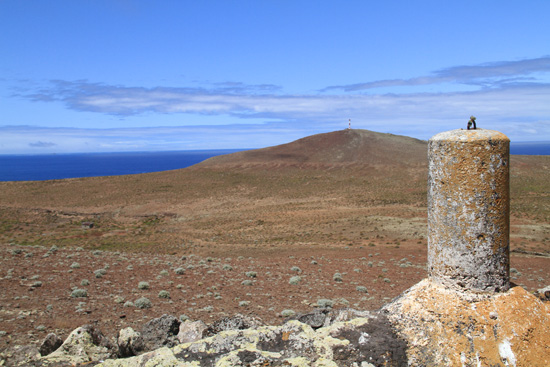
Los escasos caminos de Salvaje Grande evocan al visitante paisajes del interior de Fuerteventura o sur de Tenerife, vegetación de escaso porte y algunas ruinas en piedra que testimonian los inútiles intentos del ser humano por colonizar este territorio atlántico, todos fracasaron, en estas islas abundan tanto las aves como escasa es el agua potable.
Amantes de la naturaleza
Cuentan los marinos que los piratas, los del parche en el ojo y pata de palo, escondían los tesoros de sus asaltos en estas remotas islas, lo que se sabe con certeza es que Las Islas Salvajes son un preciado reclamo para los amantes de la ornitología.
Principia Islas Salvajes
Una de las imágenes habituales en este archipiélago. / JUANJO MARTÍN
En sus pequeñas superficies anidan y habitan aves muy difíciles de observar en otros lugares como el Petrel de Bulwer, el Paiño pechialbo o el Paiño de Madeira. Con paciencia o en su defecto, con migas de pan, es posible también observar a los siempre hambrientos lagartos de las islas como el Podarcis dugesii o el perenquén Tarentola boettgeri.
A pesar de su reducido tamaño, en ellas se alcanza a encontrar hasta ocho plantas endémicas, como una magarza que sólo habita en los 300 metros cuadrados de Salvaje Pequeña, que como su nombre indica, es menor que la isla principal pero aun mayor que Salvajita,con apenas 100 metros cuadrados.

ILHAS SELVAGENS - General information

Cory's Shearwater, Selvagem Grande
Photo: Bosse Carlsson

The Selvagens are a small, isolated, almost uninhabited (except for the wardens on Selvagem Grande) and seldom visited archipelago lying between Madeira and the Canary Islands. As with Madeira, they are Portuguese territory (their Portuguese name, Ilhas Selvagens, actually means 'wild islands') and, as with all of the Macaronesian Islands, they are volcanic in origin.
The archipelago consists of two groups and has a total area of 283 hectares (2.83 km²). The northeast group comprises Selvagem Grande and two smaller islets, Palheiro de Terra and Palheiro do Mar. The southwest group comprises Selvagem Pequena (30 ha) and Ilhéu de Fora (8 ha) as well as numerous smaller islets, including the Alto, Comprido and Redondo Islets, and also the tiny group of the Norte Islets. These islets as well as several small rocky reefs surrounds the southwest group, which makes it difficult to land to any of these islands. The Selvagem Grande and Selvagem Pequena islands lie 10 nautical miles (15 km) apart.
On Selvagem Grande there is a permanent field station manned by two wardens year-round, while Selvagem Pequena is manned by two wardens between May and October. These are the only human inhabitants on the islands during the whole year. The wardens are replaced every third week by the Portuguese Navy.
The islands are too small and too low to create a proper balanced climate of their own. Therefore they are very dry (recalling much of the Desertas Islands south-east of Madeira) and the temperature are higher than on Madeira. There is a cistern with capacity of 113 metric tons of water, which fills from the rain and was recuperated in 1967. There is a second cistern, built more recently by the warden's house, with a capacity of some 80 metric tons. Occasionally winds from SW bring exceptionally heavy rainfall, on the other hand dry winds from the east carry dust and many migrant birds from Africa, especially during the migratory season. To fill the cisterns it is necessary to have heavy rain and it has been known not to rain for three consecutive years!

Selvagem Grande
This is the largest island in the archipelago and has an area of 2,45 km². It is pentagon shape and has steep cliffs, 70-90 metres high above sea-level. The interior is flat, on average about 100 metres. Only three summits, remnants of former volcanic cones, overlook the plateau with a maximum height of 163 metres (Pico da Atalaia).
Since the 15th century goats live on the island, brought there as living supplies for sailors. Later rabbits and mice (probably accidentally) were introduced. Fortunately the goats disappeared at the end of the 19th century due to hunting, but rabbits and mice only disappeared in 2003 by an eradication programme developed by the Natural Park.
Several hundred years ago the Shrub Tobacco from South America was imported/introduced for firewood and spread rapidly. This plant is also included in a separate eradication programme, organized by the Natural Park.

Selvagem Pequena
Much smaller than Selvagem Grande (0.3 km²) and has a much more rugged and rockier coast. Pico Veado is the highest point at 49 metres, the rest of the island is rather flat island (only 5-10 metres above sea level). Selvagem Pequena and Ilhéu de Fora were spared the introduction of rabbits and goats, which means they still have the most original and untouched vegetation of all Macaronesian islands. Therefore the vegetation here is more varied than on Selvagem Grande.

Ilhéu de Fora
The smallest (0,081 km²) of the three larger islands in the archipelago and very similar to Pequena in habitat. It too, is covered with limy sands on its flat plateau, which rises only up to 18 metres above sea-level.

Discovery and its protection today
The first recorded official discovery of the Selvagens dates from 1438, when Diogo Gomes de Sintra sighted them when returning to Portugal from Guinea, nineteen years after the discovery of Madeira. At that time, the Portuguese discoverers consistently expanded the horizons of European knowledge.
The Selvagens were awarded the Diploma of the Council of Europe, a diploma which it still holds. In 2003 these islands were selected to be the national candidates for the UNESCO World Heritage List. They withdrew their application so that a formal application could be made at a later date in more detail.
As a matter of curiosity the famous Jacques-Yves Cousteau once said he found the cleanest waters in the world around Selvagens Islands.

9 de julho de 2011

The Birds of Madeira: Zino's Petrel


The Zino's Petrel or Freira, Pterodroma madeira, is a small seabird in the gadfly petrel genus which is endemic to the island of Madeira. This long-winged petrel has a grey back and wings, with a dark "W" marking across the wings, and a grey upper tail. The undersides of the wings are blackish apart from a triangle of white at the front edge near the body, and the belly is white with grey flanks. It is very similar in appearance to the slightly larger Fea's Petrel, and separating these two Macaronesian species at sea is very challenging. Zino's was formerly considered to be asubspecies of the Soft-plumaged Petrel, P. mollis, but they are not closely related, and Zino's was raised to species status because of differences in morphology, calls, breeding behaviour andmitochondrial DNA. It is Europe's most endangered seabird, restricted to a few ledges high in the central mountains of Madeira.


Zino's Petrel nests in burrows which are visited only at night, to the accompaniment of their haunting calls. The single white egg is incubated by both adults, one sitting during the day while the other feeds on fish and squid at sea. Eggs, chicks and adults have been subject to predation by introduced cats and rats, and in the past have been taken for food by local shepherds. Predator control, and other measures such as the removal of grazing animals which trample the burrows, has enabled the population to recover to 65–80 breeding pairs; it remains Endangered on theIUCN Red List. However, conservation efforts had a major setback in August 2010 when fires killed three adults and 65% of the chicks.

Taxonomy

The gadfly petrels in the genus Pterodroma are seabirds of temperate and tropical oceans. Many are little-known, and their often similar appearance have caused the taxonomy of the group to be rather fluid.[2] The forms breeding in Macaronesia on Madeira, Bugio in the Desertas Islands, and in the Cape Verde archipelago were long considered to be subspecies of the Southern Hemisphere Soft-plumaged Petrel, P. mollis, but mitochondrial DNA analysis, and differences in size, vocalisations, breeding behaviour, showed that the northern birds are not closely related toP. mollis,[3] and that the Bermuda Petrel or Cahow may be the closest relative of the Macaronesian birds.[2] Sangster recommended establishing Zino's Petrel on Madeira and Fea's Petrel on the Desertas and Cape Verde as full species,[3] and the species split was accepted by the Association of European Rarities Committees (AERC) in 2003.[4]
Sangster estimated that the two Macaronesian species diverged at the end of the Early Pleistocene, 850,000 years ago,[3] although the methodology used to establish this time scale has subsequently been questioned.[5] An analysis of feather lice taken from Fea's Petrels, Pterodroma feae deserti, from Bugio Island, and from Zino's Petrels from the Madeiran mainland showed that there were marked differences between the two seabirds in terms of the parasites they carried, suggesting that they have long been isolated, since lice can normally only be transferred through physical contact in the nest. The species on Zino's Petrel are most similar to those of the Bermuda Petrel, whereas Fea's Petrel's lice are like those of Caribbean and Pacific Pterodromaspecies. This suggests that despite the close physical proximity of the two species of gadfly petrel found in the Madeiran archipelago, they may have arisen from separate colonisations of mainland Madeira and, later, the Desertas Islands.[6] Although their reproductive isolation has allowed the separate evolutionary development of the two species, genetic evidence shows the three Macaronesian petrels are each others closest relatives.[7][8]
The petrels breeding in the high central mountains of Madeira were first recorded in 1903 by German naturalist and priest Ernst Johann Schmitz, who failed to realise that they were different from the Fea's Petrels he had seen in the Desertas. The species was formally described as a race of Soft-plumaged Petrel by Australian amateur ornithologist Gregory Mathews in 1934.[9] Following the recognition of the Madeiran birds as a full species, they were named after the Portuguese ornithologist, Paul Alexander Zino, who was instrumental in their conservation during the latter half of the twentieth century. The genus name Pterodroma is derived from Greek πτερον, pteron, "a wing", and δρομος, dromos, "running", and refers to the bird's swift erratic flight.[10] The specificmadeira refers to the island on which it breeds. The Portuguese name Freira means "nun"; the inhabitants of Curral das Freiras (Nun's Valley) near the breeding site claimed that the nocturnal wailing of the petrels in the breeding season were the calls of the suffering souls of the nuns. The sisters had taken refuge in the valley from attacks on the island by French pirates in 1566 that lasted for 15 days.[11][12]
Pterodroma petrel remains dated at between 60,000 and 25,000 years BP were found in two cave sites in Gibraltar. They consist of a more abundant form similar in size to Zino's, and a larger, less common type. It is uncertain whether they represent the site of a former breeding colony, or are the result of a seabird wreck in which storms blow birds inland. They do suggest, however, that members of the genus were formerly more widespread.[13]

Description

This long-winged petrel is 32–34 cm (12.5–13.4 in) long with an 80–86 cm (31–34 in) wingspan,[14] and an average weight of 290 g (10.3 in).[15] It has a grey back, grey wings with a dark "W" marking across them, and a grey upper tail. The undersides of the wings are blackish apart from a triangle of white at the front edge near the body, and the belly is white with grey flanks. The head has a mottled whitish-brown forehead, a dark cap, and a dark spot below and behind the brown eye. The bill is black and the legs are flesh pink, the colour continuing onto the first third of the feet, the rest of the toes and webs being black-brown.[16] It gives the general impression of a small Cory's or Great Shearwater, with a fast flight; in strong winds it shears high above the surface with angled wings.[14] Nothing is known of the fresh juvenile plumage or the moult sequence, and ageing birds is currently not feasible.[15]
This species is very similar in appearance to the Fea's Petrel, but is smaller. The size difference and lighter flight may not be apparent at sea, especially with lone birds, but a recent study helped to clarify other useful features. Zino's has a diagnostically small, delicate, often rather long and slender bill, which may be obvious in the most slender-billed examples, which are probably mostly females, but can be difficult to determine in larger-billed, probably adult male, birds. Another useful feature is a large whitish panel on the underwing. The wing panel is exclusive to Zino's but is only shown by 15% of the birds. Zino's has a more rounded wing tip, but P. feae deserti sometimes shows a rounded wing tip, so this feature is not diagnostic. Previously suggested criteria such as head, upperwing and flank patterns were found to be inconclusive.[15] Off the eastern United States and the Azores, both Macronesian petrels are easily distinguished from the larger Bermuda Petrel by that species' upperparts, which are uniformly dark but for a pale grey rump.[17]
This species at its breeding sites gives a long mournful call like the hooting of a Tawny Owl, and a much less frequent sound like the whimpering of a pup. It is silent at sea.[18] The breeding calls are very similar to those of Fea's Petrel, and Bretagnolle's analysis of the calls of the Soft-plumaged Petrel complex led him to suggest in 1995 only a two-way species split, with the northern forms madeira, feae and deserti all as subspecies of Fea's Petrel.[19]

"Snowy-winged petrel"


Distribution and habitat

The Hadoram Shirihai expeditions to the Madeira archipelago in 2008, 2009 and 2010 each had sightings of a Pterodroma petrel (possibly the same bird) with largely white underwings, but upperwings like Zino's or Fea's. This plumage does not correspond to any known Pterodroma species. It may have been an unusual variant of Zino's but this is unlikely since no similar bird has been seen amongst the more than 100 caught at the nest. It may alternatively be a single aberrant individual, a hybrid or an unknown taxon from Madeira or elsewhere. No conclusion is possible on current knowledge.[15]
This petrel is only present in Madeiran waters during the breeding season. Its distribution at sea during the rest of the year is poorly known due to the rarity of the species and the difficulty of separating it from other Pterodroma petrels at sea.[1][14][18] Birds identified as either Zino's or Fea's have been recorded from both sides of the North Atlantic, and in Ireland and Britain there has been a large increase in the number of reports, perhaps because global warming brings increasing numbers of tropical species into temperate waters. The timing of the reports, mainly in late spring and summer in the western North Atlantic, and in late summer and early autumn in the east, has suggested that birds follow a clockwise route around the North Atlantic after leaving their breeding sites. However, the few birds that have been identified with certainty have all been Fea's.[13] Zino's Petrel may have a similar strategy, since preliminary results from geolocation studies indicate widespread dispersal over the North Atlantic central ridge during the breeding season, and migration towards the Brazilian coast in the non-breeding period. Pterodroma petrels have been recorded in the Canary Islands and the Azores on surprisingly few occasions;[15] a claim of possible Zino's from South Africa is now thought to be erroneous.[13]
Zino's Petrel is endemic to the main island of Madeira, where it breeds on inaccessible and well-vegetated ledges in the central mountains between Pico Areeiro and Pico Ruivo. The typical ledge plants are endemic hemicryptophytess and Chamaephytes, but grasses may also be present.[20] It nests at heights above 1650 m (5400 ft). It was formerly more widespread, since subfossil remains have been found in a cave in eastern Madeira, and on nearby Porto Santo Island. The breeding ledges have to be inaccessible to introduced goats so that they remain rich in endemic flora. The vegetation ensures that there is sufficient earth on the ledges to allow the birds to burrow and make their nests, and trampling by grazing animals reduces the soil cover.[21]

Behaviour

Breeding

Zino's Petrel breeds two months earlier than the Fea's Petrel's on Bugio, only 50 km (30 mi) away. The birds return from sea to their breeding grounds in late March or early April and courting occurs over the main breeding area during the late evening and early morning hours.[9] The nest is a shallow burrow or old rabbit tunnel up to 140 cm (55 in) long in thick soil on vegetated ledges. The length of the burrow is related to the age of the pair that uses it, young birds making shorter tunnels, which are extended in subsequent years. The oval white egg is laid from mid-May to mid-June in a chamber at the end of the burrow and incubated for 51–54 days, each parent alternating between sitting on the nest and feeding at sea.[18][20] The young fledge about 85 days later in late September and October. This petrel is strictly nocturnal at the breeding sites to avoid predation by gulls. It stays 3–5 km (2–3 mi) offshore during the day, coming to land in darkness. It calls from about 30 minutes after nightfall until dawn, including on moonlit nights.[18]
This species mates for life, and pairs return to the same burrow year after year. The single egg is not replaced if lost.[22] This is a long-lived species: one bird has returned to its burrow for ten consecutive years,[16] and the lifespan is estimated to be about 16 years.[1] The age of first breeding is unknown, but assumed to be four or more years.[20] Despite the proximity of the breeding sites, Zino's and Fea's Petrels have never been found at each others' nesting areas,[15]and Zino's is not known to hybridise with any other species.[23]

Feeding

Zino's Petrel, like its relatives, feeds on small squid and fish. The vomited stomach contents of one bird contained cephalopods, the bioluminiscent fish Electrona risso and small crustaceans.[21] Like other small petrels, Zino's does not normally follow ships.[22]

Predators and parasites

Their nocturnal approach to the breeding sites means that Zino's Petrels avoid the attentions of gulls or diurnal raptors, and the only owl on the island, the Barn Owl, is a rodent hunter. Other than bats, there are no native land mammals on Madeira, although there are a number of introduced species, two of which will take birds or chicks.[24] These are Brown Rats and feral domestic cats. Even the high mountain nest sites of the Zino's Petrel are not safe from these adaptable predators, ten adults being killed by cats in 1990.[21][25] Feather lice found on Zino's Petrels include Trabeculus schillingi, Saemundssonia species and an unnamed species of Halipeurus.[6]

Conservation status

Zino's Petrel has a very restricted range on the mountaintops of a single island, and is the most endangered European seabird.[26] The birds, already confined to a limited area when discovered, were thought to be extinct by the mid-twentieth century.[9] Two freshly fledged juveniles were found within the walls of the governor's palace in Funchal in the early 1940s, presumably attracted there by lights, but the species was not seen again until 1969.[22] In 1969, Paul Zino played a tape of Fea's Petrel from Bugio to a shepherd from Curral das Freiras; he immediately recognised the call, and led the researchers to the remaining nesting area. Predation by introduced rats meant that breeding success in the small population was low, and no young at all fledged in 1985. The Freira Conservation Project was founded in 1986 with the aim of increasing the population of Zino's Petrel by controlling rats and human interference; the control was extended to cats after the mass predation of 1990.[9]
There are now 130–160 known individuals (65–80 breeding pairs) confirmed to breed on just six ledges. There may be some disturbance from visitors at night and from the construction of a NATO radar station on the summit of Mount Areeiro, and in the longer term climate change may have an adverse effect, since all nests are within 1,000 m (3250 ft) of the top of the highest mountain in the breeding area. Formerly, shepherds collected nestlings for food, and egg collectors have raided burrows. Currently, the main threats continue to be predation of eggs and chicks by rats, and of nesting adults by feral cats,[1] although at much reduced levels due to trapping.[9]
Zino's Petrel is protected under the EU's Wild Birds Directive, and its breeding sites lie within the Parque Natural da Madeira national park. Following the purchase of about 300 ha (740 acres) of land around the main breeding site, all livestock has been removed from the breeding areas, allowing the vegetation to recover, although breeding still only occurs on ledges that were never accessible to grazing animals. The research and predator control by the Freira Conservation Project and the national park which started in 1986 was expanded in 2001 with additional EU funding. The increase in productivity (29 chicks fledged in 2004) meant that this species was downgraded from Critically Endangered to Endangered on the IUCN Red List in 2004. Its population appeared to be stable or increasing slightly up to the summer of 2010.[1]
A disaster struck the colony on 13 August 2010, when a forest fire swept through the breeding site killing three adults and 25 of the 38 chicks. The fire destroyed the vegetation and several nesting burrows. Conservation action to protect the 13 remaining chicks included removing dead birds and burnt vegetation, reinforcing the surviving nests, and setting poison bait for rats around the now exposed nest sites. In the longer term, the action plan includes the provision of artificial burrows, seed dispersal to help the vegetation recover, and the use of anti-erosion materials.[27]
Source: Wikipedia
Related Posts Plugin for WordPress, Blogger...

Ratings and Recommendations by outbrain